Two Systems You Rarely Think About Until Something Goes Wrong
Most homeowners in Cathedral City think about their garage door springs when something breaks — springs are dramatic, snapping loudly and leaving the door completely inoperable. But the lift cables and guide tracks that work alongside those springs are just as critical to safe, smooth door operation, and their failures can be equally dangerous. At Garage Door Service Superior Cathedral City, cable and track calls are among our most common service visits, and the urgency of these repairs is often underestimated by homeowners who try to keep using the door after a problem appears.
Whether you live in a single-family home in Cathedral Canyon, a golf course community in Date Palm Country Club, or a neighborhood property in Rio Del Sol, understanding how these components work — and when to call for help — can prevent a minor repair from becoming a costly emergency.
How Lift Cables Keep Your Door Safe
Garage door lift cables are galvanized or stainless steel wires that run from the bottom bracket at the base of the door up and around the cable drums mounted at each end of the torsion spring shaft. As the spring unwinds, it rotates the drums, which reel in the cables and pull the door upward. When the door closes, the spring winds back up as the cables unspool.
This means your cables are under constant tension — significant tension — every single time the door moves. Over time, several things can cause a cable to fail:
- Normal wear and fraying — the cable wraps and unwraps thousands of times over its life, and individual wire strands begin to break, creating a frayed appearance before the cable snaps entirely.
- Corrosion — even in Cathedral City's dry desert climate, garage humidity from vehicles and irrigation can corrode cable strands, especially where the cable wraps around the drum.
- Spring failure — when a spring breaks, the sudden change in tension can cause a cable to slip off its drum or snap under the uneven load.
- Improper repair — DIY spring replacements or opener adjustments that alter cable tension can cause cables to unspool or fray prematurely.
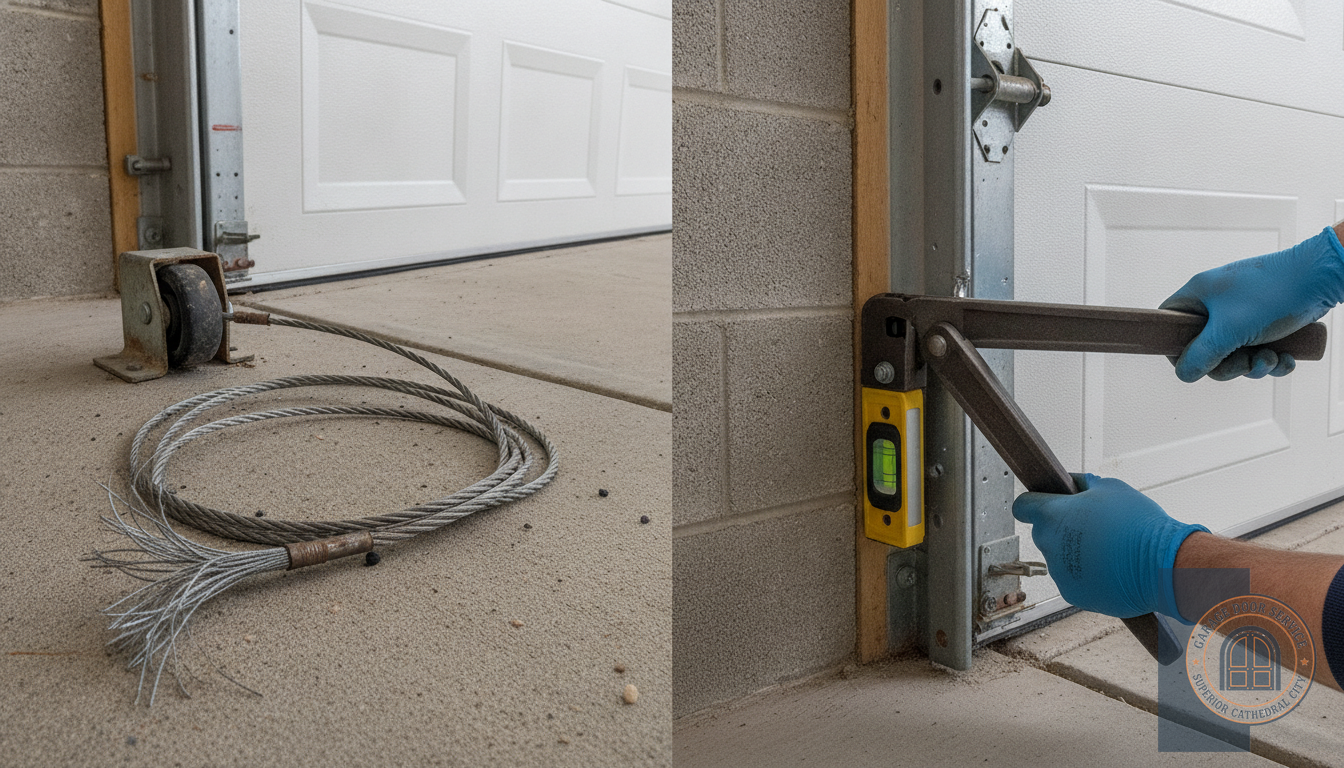
A broken cable typically causes one side of the door to drop lower than the other, making the door look crooked or causing it to bind in the tracks. You may also see coiled wire lying on the garage floor near the bottom corner bracket. Stop using the door immediately — a partially attached door can drop without warning and cause serious injury or crush a vehicle. Call our garage door cable repair team right away.
What Our Cable Repair Service Covers
Our technicians arrive stocked with galvanized cables pre-cut to standard lengths for single and double-car residential doors. Here is what happens during a cable repair visit:
- Safely relieve spring tension before touching any cable hardware.
- Remove the damaged or broken cable from the bottom bracket and drum.
- Inspect the cable drum for wear, cracking, or groove damage that would cause the new cable to fray prematurely.
- Inspect the bottom bracket — the anchor point where the cable attaches at the door's base — for bending or cracking.
- Install and properly spool the new cable with correct tension on both sides so the door lifts level.
- Cycle the door several times to confirm even travel and test the opener's auto-reverse function.
Because cable failures and spring failures are closely related, we inspect the full spring assembly during every cable call. If your springs are approaching end of life, we will tell you honestly so you can decide whether to replace them now and avoid a future service call. Pairing a cable repair with a preventive tune-up is also a smart move — it means a technician has eyes on every component of your system at once.
How Tracks Get Damaged — and Why Alignment Matters
Your garage door's vertical and horizontal tracks are the rails that rollers ride inside as the door travels up and down. They must be precisely plumb, level, and spaced to keep the door traveling smoothly. In Cathedral City, tracks get knocked out of alignment in several common ways:
- Vehicle impact — a car bumper catching the bottom of the door or a side mirror clipping the vertical track is one of the most common causes of bent track sections.
- Loose mounting hardware — lag bolts anchoring the track to the wall loosen over time, especially as temperature changes cause wood framing to expand and contract.
- Worn rollers — when nylon or steel rollers wear down, they create uneven pressure on the track walls, gradually pushing them out of alignment.
- Structural settling — older Cathedral City homes occasionally experience minor foundation or framing movement that shifts track mounting points over time.
Symptoms of misaligned tracks include a grinding or scraping sound when the door moves, a door that sticks or jolts partway up, visible daylight gaps between rollers and the track wall, or a door that looks crooked when closed. Left unaddressed, misaligned tracks accelerate wear on rollers, strain the opener motor, and can eventually cause the door to jump the track entirely — a dangerous and costly failure mode.
Our Track Repair and Alignment Process
Our garage door track repair and alignment service covers the complete track system — vertical rails, horizontal rails, rear hangers, and the end curves that redirect the door from vertical to horizontal travel. Here is our process:
- Inspect all track sections for bends, kinks, cracks, and corrosion.
- Straighten minor bends using specialized track-bending tools — not all damaged sections require replacement.
- Replace severely kinked, cracked, or twisted sections with new galvanized track matched to your door's width and weight.
- Re-plumb vertical tracks with a level and re-tighten or replace mounting brackets and lag bolts.
- Adjust the gap between the roller and track wall to manufacturer specification — too tight causes binding, too loose allows the door to rock.
- Lubricate tracks and rollers and test through several full door cycles.
We also check roller condition during every track call. Worn rollers are a leading cause of track damage, and replacing them at the same visit — rather than on a second trip — saves you time and money. Ask about combining track alignment with a full system tune-up for the most comprehensive single-visit service we offer.
Don't Wait on Cable or Track Problems
Unlike a squeaky hinge or a slow opener that you can live with for a while, cable and track problems are progressive — they get worse with every cycle and can reach a dangerous tipping point quickly. A door that is running crooked is placing uneven stress on every other component in the system, from the springs to the opener trolley carriage.
Garage Door Service Superior Cathedral City serves all Cathedral City neighborhoods seven days a week, 8 AM to 6 PM, including Demuth Park, Palm Springs Vista, and Rancho Mirage. Call us at +17607333234 or email [email protected] the moment you notice a cable or track issue — same-day service is available for most locations in the 92234 area and surrounding Coachella Valley communities.